What did eggs cost? Browse dated price photos, or choose U.S. average to explore the monthly retail price.
Each photo shows its posted package price and quantity. The average and chart use per dozen. Fresh milk in a known quart or half-gallon package is plotted as a clearly labeled gallon equivalent; the photo price stays unchanged. Canned milk or unknown quantities stay in the photo collection without a comparable chart point. The average covers large white Grade A chicken eggs in a dozen carton, including organic, non-organic, cage-free, free-range and conventional eggs. A photo can show a different size, grade or specialty product; its label is retained. The first two numbers show the photographed price and the U.S. average from that time. The third converts one of those prices into current dollars; tap it to switch between the photo and the average. The chart has its own dollar switch. A converted price is not today’s selling price.
Convert any amount, either way Amount ($) From year or month ⇄ To year or month
Inflation comparisons use the U.S. CPI-U, all items, not seasonally adjusted . A month uses that month’s index; a year-only photo uses the year’s average. The month in “In Current” is the latest published CPI month and updates as new data arrives. CPI compares general purchasing power, not wages or driving costs.
Where the averages come from
The Bureau of Labor Statistics publishes monthly average retail prices for U.S. cities, not a price for every store or day. Missing months stay missing. A year-only photograph uses the mean of all twelve published monthly prices, only when every month is available; this is a calculated mean, not a separately published annual price.
How we choose a photo A monthly average can match a photo from the same month only when its product, per dozen unit and date are verified. Large Grade A eggs · per dozen is the comparison; other variants must be explicitly approved before automatic matching. Specialty or uncertain products remain browseable but are excluded from automatic matching.
The photo keeps its own date and price. Stores and stations can charge more or less than the national average.
Photo sources and locations
The small i on each photo shows who took it, where it came from and its license. Some photos allow noncommercial use only; those are marked there.
Some dates and places are approximate. “c.” means “circa,” or “around.” A map pin may show a town or a wider area. Check the photo’s i for how much we know.
More about the data
BLS average-price estimates show the price level for the item mix sampled in each month. That mix can change over time, so this line is not a fixed-basket measure of inflation; an item’s CPI index is more appropriate for measuring price change. The current-dollar conversion uses all-items CPI. All prices are in U.S. dollars and are not seasonally adjusted. The average covers large white Grade A chicken eggs in a dozen carton, including organic, non-organic, cage-free, free-range and conventional eggs. A photo can show a different size, grade or specialty product; its label is retained.
When only a month or year is known, we place the photo halfway through it. A decade-only photo sits in the middle of the decade and shows the mean of its annual averages. It isn’t used for price matching.
The map uses public-domain Natural Earth data .
32 photographs. Average data downloaded 2026-09-27.
Gasoline · Milk · Eggs
Browse by year 1936 · 1939 · 1940 · 1945 · 2007 · 2010 · 2013 · 2017 · 2019 · 2020 · 2022 · 2023 · 2025 · 2026
Download photo records · Download average data
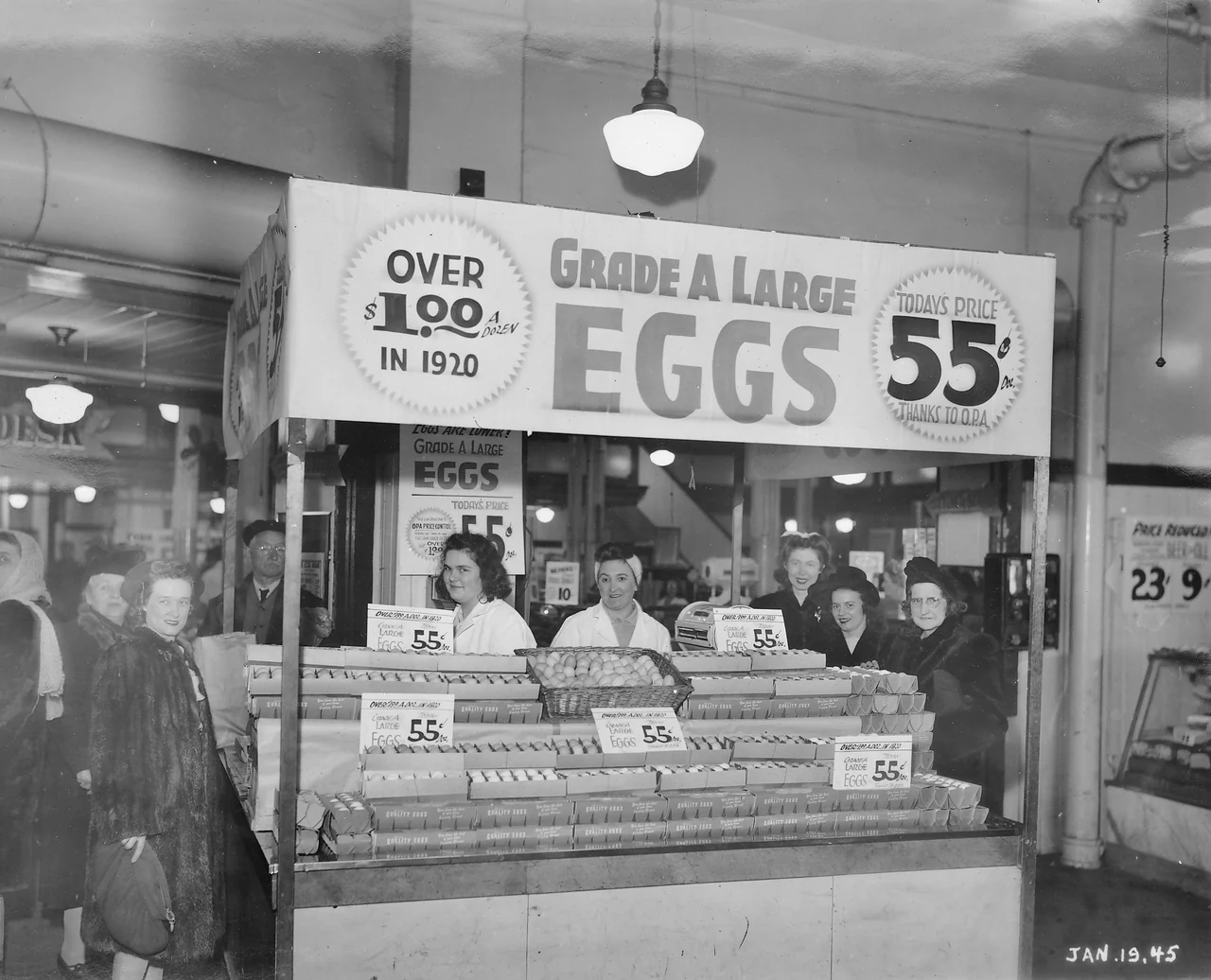
Notes on this photo The photograph shows a real grocery egg display with an overhead TODAY’S PRICE 55¢ DOZ. sign and smaller Grade A Large Eggs 55¢ cards. The 1920 price on the banner is historical advertising copy, not a 1920 observation. The date is written on the photograph, while the NARA exhibit labels the item undated. The exact store and city are unknown. Egg color is not stated, so this point is not automatically matched to the modern white-egg average. The NARA online exhibit supplies a 2210 × 1788 embedded JPEG; no larger scan is linked there. The 55¢/dozen sign and Grade A Large wording are readable at this resolution.